Project Shadow 1.0.1 — R1 Reference
6f6f1e16d5e9a20e62403f14af7ce8629ce2d702528fb7f80aaf4a14deb7a1d1The exact 5,731,663-byte PRELIVE public reference. It contains no Myth package and authorizes neither production nor consequential deployment.
Project Shadow R1.0.1 is the current R1 reference. The August 14 R1 release is a preserved historical predecessor superseded by R1.0.1.
Project Shadow 1.0.1 contains no Myth package. Generic Myth v0.2.0 and Full-Canon Myth v0.3.5 are separate optional companions; both default off, neither is required by R1, and neither can authorize action or change an R1 result.
No production or consequential deployment is authorized. No global green.
Project Shadow 1.0.1 · corrected R1 reference · beta-active-testing · PRELIVE
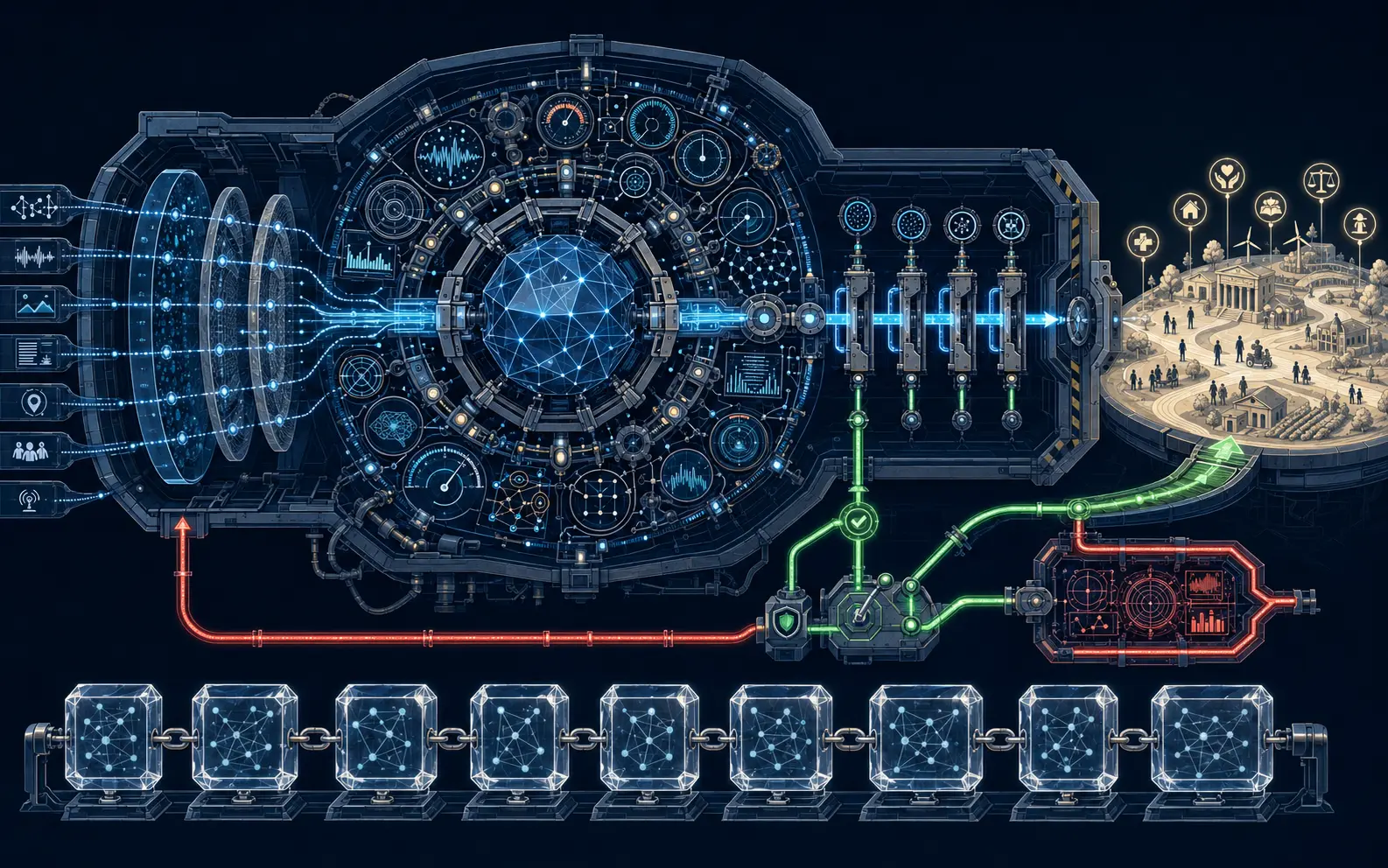
Project Shadow is a civic and technical quality system designed to make power explain itself. It instruments and challenges the path from context and evidence to action, authority, consequence, appeal, correction, and verification.
The exact R1.0.1 public reference is published as PRELIVE and contains no Myth package. PBHP remains in active joint testing with Project Shadow. Publication supports inspection; it is not production deployment authorization, independent validation, certification, legal compliance, or a global safety claim.
The Myth-free inner family is admitted and the exact outer release is authorized. Generic Myth v0.2.0 and Full-Canon Myth v0.3.5 remain separate optional companions. The August 18 CAPA closure is preserved as history; six-site effectiveness reverification is pending after an external adversarial finding. None of these facts establishes operational readiness.
Read the release receipt →Read the CAPA →6f6f1e16d5e9a20e62403f14af7ce8629ce2d702528fb7f80aaf4a14deb7a1d1The exact 5,731,663-byte PRELIVE public reference. It contains no Myth package and authorizes neither production nor consequential deployment.
c8c32b12432c954b1a6f852c0c9f81bbbd40167e936be057d4c3de1a0aa3a623The exact 5,463,189-byte inner family. All 27 active descendants are byte-identical to August 14; zero operational descendant bytes changed. Member-set digest 7a557efad953cbafd9e3ea9eb29b2d3e3e1bc6ab99dcf6b9ae7a99c487b0754d.
1ffdba41025c0b81da92d0bbb22d0eaa69488cffbc80936365034669110448d742 primitives and 10 compositions form the exact admitted modular commons surface.
6e7a362d4135f9d626dcfef463bfb1f7166226b3cf8a4c02a953ab39af1538bfThe exact 93,676-byte public companion is separate, default-off, terminal-only, nonauthorizing, and not required by R1.
2b55867fe7c502a0defd8d6f2e9b53fbd1caaf1b0f225a438bd45b04a3e7bae2The exact 1,428,812-byte optional companion is separately versioned, default-off, nonauthorizing, and outside canonical R1.
2f8fe1530b6a83294d15011df95853aaecf08fa4dba756f0c2e91dd089e1b1ecThe immutable 7,679,812-byte predecessor remains historical evidence. Its signatures and receipts do not authenticate R1.0.1.
075b41ea4186b2d2edb0ed246ab7662cf8bbdf3160294e3eca176b9d0857b108Preserved historical identity. The current 27 active descendants are byte-identical while the family container removes the embedded Myth package.
You do not need the mythology—or the whole architecture—to use one bounded piece. Every path keeps the evidence and authority boundary attached.
Use Pause Before Harm to name the action, identify who pays first, find the Door, and leave a receipt.
OPEN →02 / TAKE ONE PIECEInspect the modular primitives and compositions. Mythology is never required for operational use.
OPEN →03 / INSPECT ITSee published and admitted identities, audit disposition, limitations, and what this release does not authorize.
OPEN →04 / CHALLENGE ITBring prior art, a custody gap, a false positive, an adverse result, or evidence that a correction did not hold.
OPEN →Project Shadow grew from regulated quality work: a form can be complete and still be false; a corrective action can close without correcting anything; a green dashboard can average away the condition that matters. The operational question became: who pays first if this model is wrong, and can they recover?
If the framework always concludes that Phillip was right, the framework is broken.READ THE ORIGIN AND DESIGN BOUNDARY →
Project Shadow is not one moral score. It is a chain of observable states, binding floors, action boundaries, challenge routes, and write-ahead evidence.
Requests, records, retrieved material, sensors, and standing constraints enter with provenance.
Freshness, compaction, relevance, contradiction, and missing information are measured—not assumed away.
Observation, inference, hypothesis, narrative frame, and uncertainty remain distinguishable.
Reusable controls keep decision signals separate. A favorable result cannot average away a binding floor.
The worst binding floor constrains the output, tool permission, escalation, or release.
Affected parties, authority, reversibility, reliance, and challenge path remain attached to the act.
Evidence, state changes, dissent, owner, stop rule, and review trigger are written before execution.
Thirteen paper-scale chapters preserve the website's earlier instrument and evaluation work. They are useful provenance and research records; they are not the exact locked R1 package or deployment proof.
Four editable scenarios exercise the earlier 28-gauge reference evaluator. Local-only and not current R1.
OPEN →02 / STUDYThe preserved earlier gauge panel, deterministic matrices, refusal floors, and limitations.
OPEN →03 / EVALUATESpecified methods, limited real-target work, adverse evidence, and open validation floors.
OPEN →04 / TRACEWhat earlier testing supported, what failed, and what remained open when R1 locked.
OPEN →05 / VERIFYCurrent exact identities, preserved research ancestry, rights boundaries, and AI contribution.
OPEN →This lab records an earlier research architecture. It remains useful for studying non-averagable floors, but it must not be described as the current R1 package inventory or as deployment evidence.
OPEN THE LOCAL RESEARCH EVALUATOR →Context load, time anchoring, source provenance, uncertainty, citations, freshness, coverage, completeness, inference distance, and contradiction.
Stakes, reversibility, receipt status, validation, operator reliance, and authority prevent confidence from inventing permission.
Tool availability, data sensitivity, injection risk, data lineage, and model mode constrain unsafe action surfaces.
Drift, focal context, drag, stale premises, mirror boundary, and anti-projection detect when the frame itself is moving.
Project Shadow focuses on the moment a model crosses into authority: who may act, what may happen, which evidence earns the action, who can stop it, and how a person affected can challenge and recover.
TRACE THE COMPLETE SYSTEM →Authority map · rights floor · distribution tests · vendor evidence · appeal · public incident receipt
Purpose limit · data boundary · human ownership · override · reliance monitoring · CAPA
Allowlist · authorization envelope · adversarial tests · independent stop · rollback · complete trace
Attribution caution · evidence labels · identity boundary · anti-capture challenge · correction path
An agency considers a vendor model to prioritize case review. Historical outcomes appear accurate, but the live workflow changes access, delay, scrutiny, and a person’s ability to challenge the result.
OPEN THE EVALUATION PROGRAM →Historical agreement may reproduce earlier policy, missingness, investigation intensity, and unequal access—not underlying need or legitimacy.
Source provenance, retrieval coverage, data lineage, stakes, authority, reversibility, validation, reliance, and contradiction cannot inherit one vendor score.
No individual adverse action. Use a narrow advisory pilot, complete logging, blinded distribution review, caseworker ownership, appeal, and independent stop.
Publish the scope, features, exclusions, false-positive burden, override patterns, incidents, correction triggers, and whether the pilot earned continuation.
The model may assist a bounded queue experiment. It does not become the final authority, and an unexplained or unrecoverable consequence closes the Door.
The symbolic layer can make ethical cognition memorable. The operational layer decides what may happen. The firewall between them is load-bearing.
Who exists, persists, depends, and can be made disposable?
Care, clarity, and paradox held without single-pillar collapse.
Action, gate, power, harm, Maybe, Therefore, receipt.
A preserved earlier 28-gauge reference panel. It is research history, not the current R1 package inventory.
Provenance, write-ahead log, challenge, CAPA, evaluation.
Enter through the locked R1 status, architecture, research instruments, governance, or provenance. Older website mechanisms remain visibly historical; no route silently becomes current R1.
OPEN COMPLETE DIRECTORY →Workstreams, repository strata, audiences, and firewalls.
ENTER →02 / FORGEFramework intake, integration modes, deduplication, and change control.
ENTER →03 / EXECUTEUnified evaluation path, thresholds, services, and codec.
ENTER →04 / OPERATEMode, anchors, drift, accumulation, compression, and FireStamp.
ENTER →05 / BINDPBHP fast path and the specialized hardener stack.
ENTER →06 / CORRECTFPV, OQL, CAPA, tribunal, release, and human effects.
ENTER →07 / CONNECTTen evaluation contracts and standards-oriented views.
ENTER →08 / RELEASEVersion reconciliation, external challenge, field evidence, and release layers.
ENTER →The strongest honest objection is written before the conclusion. Weak, evasive, or missing dissent hardens the floor.
Stakeholders are ordered least-powerful-first. Power asymmetry multiplies rigor and never discounts harm.
The action, evidence, unknowns, gate, provenance, dissent, and review trigger are written before execution.
Project Shadow is a locked, admitted-as-scoped reference beta. It is not a validated deployment, a safety or efficacy proof, a certification, a legal-compliance determination, fresh independent validation, or a global verdict.